Elimination Period
Contract delay that must be satisfied before disability benefits start.
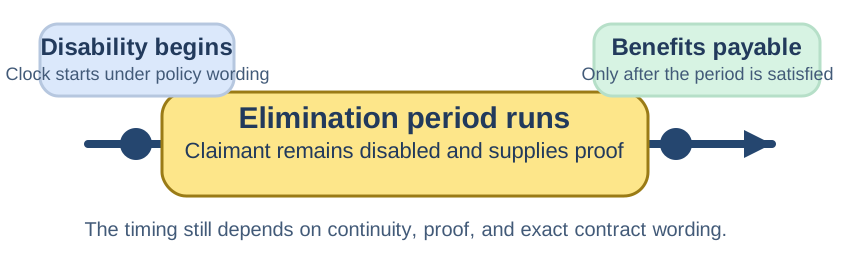
An elimination period is the contractually defined stretch of time that must pass after a covered disability begins before benefits become payable.
Why It Matters
In disability coverage, timing is almost as important as the monthly benefit amount. A claimant can have valid coverage and still receive no cheque for weeks or months because the elimination period has not yet been satisfied.
That delay affects how readers plan for emergency savings, employer sick-leave usage, short-term disability, and the handoff into long-term disability coverage.
How It Works In Canadian Insurance Context
In Canadian disability wording, the elimination period usually measures a set number of days during which the insured must remain disabled and continue meeting the policy conditions before benefits start. It often appears in:
- individual disability insurance
- workplace short-term disability or long-term disability
- related riders such as waiver of premium
The practical question is usually not just how many days are listed in the schedule. It is also when the clock starts, whether disability must be continuous, what medical proof is required during the period, and how partial return-to-work attempts are treated.
Where Readers Usually See It
| Setting | What the elimination period does | Why readers notice it |
|---|---|---|
| Individual disability policy | Delays income-replacement benefits after disability begins | It determines how long the insured must self-fund before payments start |
| Group long-term disability plan | Bridges the period before LTD benefits attach | It often interacts with sick leave or STD coverage |
| Waiver-of-premium rider | Delays when premium obligations stop | A policy can stay in force, but relief from premium may not start immediately |
Practical Example
A group LTD plan has a 120-day elimination period. The employee stops working on April 1 because of a serious illness and remains continuously disabled. Even if the claim is eventually accepted, LTD benefits would not usually begin until that 120-day period has been satisfied under the plan wording.
If the employee has employer sick leave or STD benefits during that same period, those benefits may function as the bridge. If no such bridge exists, the claimant may need to rely on savings or other resources until LTD begins.
Elimination Period Vs Waiting Period
| Term | Main idea | Common use |
|---|---|---|
| Elimination period | Benefit-start delay after disability begins | Disability policies and waiver-of-premium wording |
| Waiting Period | Delay before coverage or benefits become available | Broader benefits usage, including plan eligibility and some disability wording |
In practice, some insurers and administrators use the two terms almost interchangeably for disability benefits. Others reserve “waiting period” for plan-entry timing and “elimination period” for claim-stage timing. The contract definition controls.
Common Misunderstandings
An elimination period is not a deductible. A deductible is a money amount absorbed by the insured. An elimination period is a time requirement.
It is also not just an administrative delay caused by paperwork. Even where the claim file is opened quickly, benefits may still not be payable until the contractual period has run.
Readers also sometimes assume the first day off work automatically counts as day one. Some wordings tie the start more precisely to disability, medical attendance, or cessation of active work.
Caveat
The result can vary with continuity rules, recurrent-disability clauses, partial return-to-work attempts, and whether the product is individual, group STD, group LTD, or a rider on another policy. The label is simple, but the timeline is always wording-sensitive.